Productivity, But Not The Way You Know It: Go For A Walk
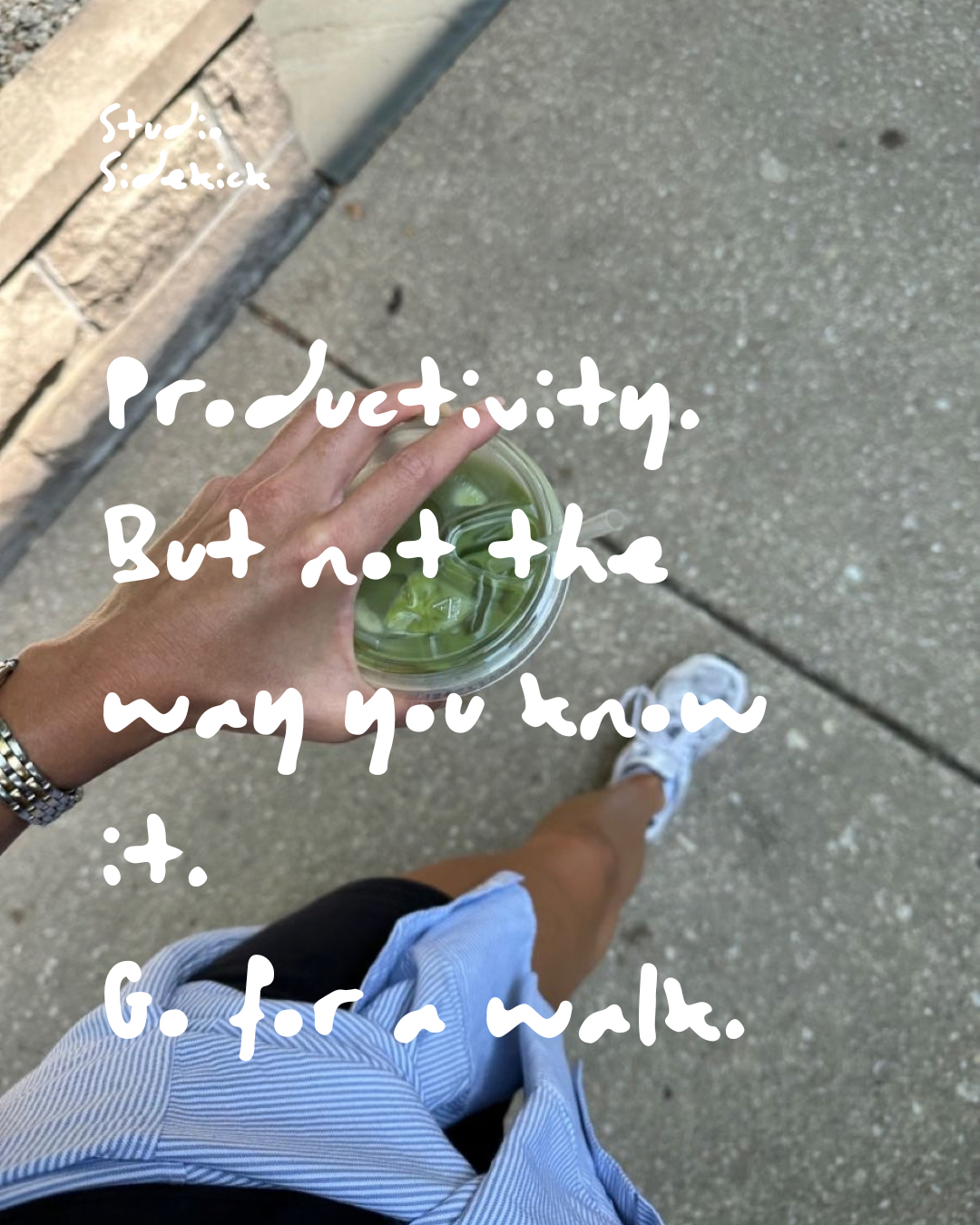
When we talk about productivity, we usually talk about doing.
Time blocking.
To-do lists.
Automations.
Getting through the inbox.
Finding another 30 minutes.
Making everything more efficient.
And I love a system as much as the next person. My Google Calendar can confirm.
But I think there’s another version of productivity that we don't talk about enough.
Go for a walk.
Not a walking meeting.
Not a “10,000 steps while listening to a business podcast at 1.5x speed” walk.
Just go outside and walk.
Because some of my best thinking happens when I’m technically doing absolutely nothing.
Not Every Productive Hour Has To Look Productive
This is something I’ve had to learn since running my own businesses.
When you work for yourself, there can be a strange pressure to make every working hour count.
If you're sitting at your laptop, you're working.
If you're replying to emails, you're working.
If you're ticking things off a list, you're definitely working.
Going for a walk at 11am on a Tuesday?
That can somehow feel a little harder to justify.
But running a business doesn't only require you to do things.
It requires you to think.
To solve problems.
To come up with ideas.
To make decisions.
To work out where you're going next.
And sometimes staring at the same screen for another hour isn't going to get you there.
Your Brain Might Actually Need The Walk
And apparently, there's something in this beyond me simply liking a walk.
A Stanford study looking at walking and creative thinking found that people's creative output increased by an average of 60% while walking compared with sitting. In one experiment, 81% of participants improved their performance on a creative idea-generation task while walking.
Which makes closing the laptop and heading outside feel considerably less like procrastination.
What's particularly interesting is that walking didn't make people better at every type of thinking.
The researchers found the benefit was particularly apparent for divergent thinking — essentially the part of our brain that's useful when we're generating ideas and exploring different possibilities. It wasn't similarly helpful for tasks requiring one focused, correct answer.
So maybe don't take your VAT return on a walk.
But the thing you've been staring at for an hour waiting for an idea?
That might be worth taking outside.
Especially When You're The Founder
When you run your own studio, your brain is constantly switching between two very different modes.
There's the doing:
Emails.
Projects.
Content.
Invoices.
Admin.
Client work.
And then there's the thinking:
Where is the business going?
What do I want more of?
What's not working?
What's the next idea?
Should I actually be doing this at all?
That second category rarely appears neatly on a to-do list.
But it's arguably some of the most important work you do as a founder.
A walk gives me somewhere for that thinking to happen.
You Don't Need To Optimise The Walk
This might be my favourite part.
You don't need to turn it into another productivity system.
You don't need a podcast every time.
You don't need to answer voice notes.
You don't need to call someone.
You don't need to track it.
And you definitely don't need to come back with three groundbreaking business ideas for the walk to have been worth it.
Sometimes the productive thing is simply giving your brain half an hour where nobody is asking anything from it.
Including you.
And while I personally like getting outside, the original Stanford research found creative benefits from walking both indoors and outdoors — suggesting the act of walking itself played an important role.
So no picturesque countryside route required.
I Put Mine In The Diary
If you've read my post about using my calendar as my to-do list, you'll know I put life in there as well as work.
And that includes a morning walk.
Not as something I can do if I finish everything else.
It's part of the day.
Because I've realised that protecting some space away from my desk usually makes me better when I come back to it.
More focused.
More creative.
Less likely to spend 45 minutes rereading the same email.
And generally a nicer person to be around, which is probably worth mentioning too.
Your brain might just be a little better equipped to deal with it.
Want More Space For The Work That Actually Needs You?
There's another side to this too.
Sometimes you don't need a better productivity hack.
You need fewer things competing for your attention.
That's where Studio Sidekick comes in — helping interior designers with the non-design side of running their studios, from social media and content to websites, SEO, systems and ongoing behind-the-scenes support.
Because the goal isn't to become incredibly efficient at doing absolutely everything yourself. It's to create a business that gives you a little more space to think, create — and occasionally go for a walk. ✷